
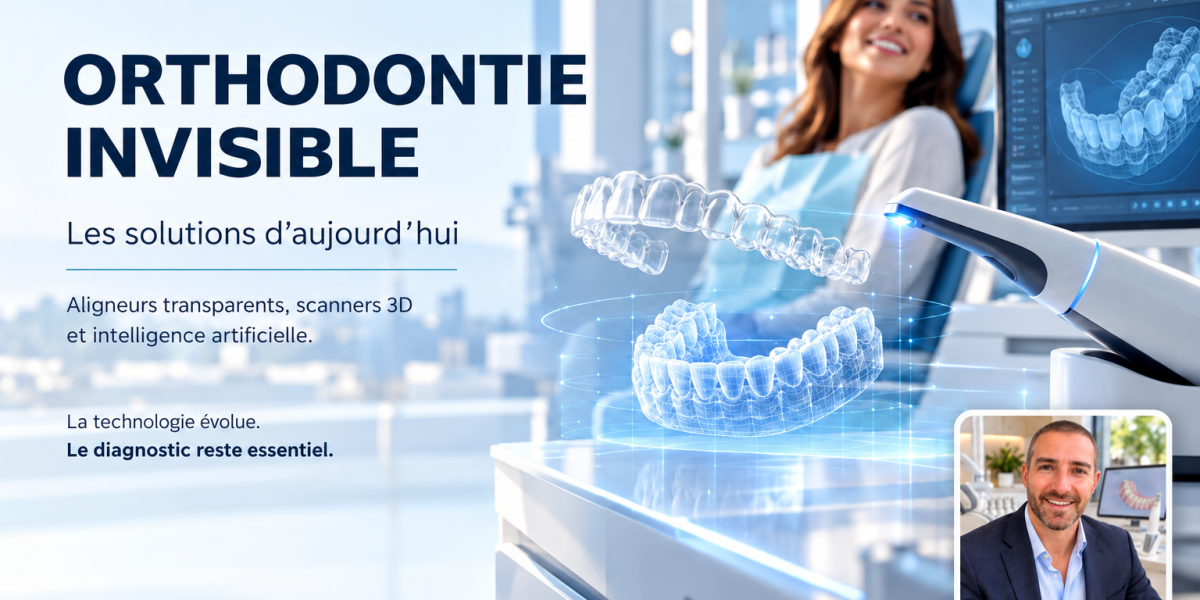
Clear aligners, 3D planning, intraoral scanners and artificial intelligence are transforming adult orthodontics. But behind the technology, one principle remains: the quality of treatment depends above all on an accurate diagnosis and an indication tailored to each patient.
New technologies have fundamentally transformed orthodontics. Treatments have become more discreet, planning more precise and monitoring increasingly digital.
But how far can we really go with clear aligners? What role do 3D planning and artificial intelligence play today? And why does the orthodontist’s clinical expertise remain crucial?
Monaco Life spoke with Dr Fred Valere(orthodontist based just outside Monaco) to take a closer look at invisible orthodontics and the technologies that are transforming the field today.
Invisible orthodontics: much more than just aligners
Monaco Life: Adult orthodontics has evolved considerably. When patients today talk about “invisible orthodontics”, what does that actually mean?
Dr Fred Valere: Invisible orthodontics is neither a diagnosis nor a single treatment technique. It encompasses different solutions that allow the position of the teeth to be corrected more or less discreetly.
For many adults, clear aligners are now a highly appreciated option. They consist of a series of removable, almost invisible trays designed to move the teeth progressively. There is also lingual orthodontics, with brackets positioned behind the teeth, as well as conventional or aesthetic fixed braces.
However, the real evolution is not only about how discreet the appliances are. Above all, it concerns the way we diagnose, plan and monitor treatments.
Modern orthodontics has become largely digital. We can scan the teeth, study the bite in three dimensions, simulate different movements and create a tailored treatment sequence before treatment even begins.
The aligner is a tool, not the treatment
Monaco Life: So the aligner is only one part of the treatment?
Dr Fred Valere: Exactly. An aligner remains a tool. It does not make the diagnosis and it does not determine the treatment strategy.
Today, there are several brands and different aligner systems. The choice of a system can be important, but it is not enough on its own to determine the quality of a treatment.
What matters most is the diagnosis, the planning of movements, their sequencing, the control of biomechanics and clinical monitoring.
Two patients who appear to have the same crowding of the front teeth may require very different approaches.
It is particularly important to take into account the position of the roots, the bone and gums, the bite, the face, the smile line, jaw function and, in adults, any existing dental restorations or periodontal issues.
The objective is therefore not simply to straighten the visible teeth. It is about achieving a functional, stable result that is harmonious with the face, while respecting the biological limits specific to each patient.
Aligners, fixed braces or lingual orthodontics?
Monaco Life: Have aligners become the only modern option in adult orthodontics?
Dr Fred Valere: No. The choice of appliance should remain linked to the diagnosis, the desired tooth movements and the patient’s expectations.
Conventional fixed appliances, with brackets placed on the outer surface of the teeth, remain a perfectly modern and effective technique. For a patient who is not necessarily seeking invisibility, they can be a very good solution and, depending on the situation, may also represent a more economical option.
There is also a particularly discreet solution: lingual orthodontics.
The brackets and wires are positioned on the inner surface of the teeth. The appliance is therefore practically invisible from the front. In this respect, lingual orthodontics offers a higher degree of invisibility than aligners, which remain very discreet but cover the visible surface of the teeth.
This technique has been refined over several decades. Orthodontists such as Dr Didier Fillion have contributed to its development, particularly through work on precise bracket positioning, digital set-ups and three-dimensional control of tooth movements.[4]
Lingual orthodontics is, however, a demanding technique. Its biomechanics are specific, clinical access is more difficult, and it requires specialised training and experience.
The experience is also different for the patient. Because the appliance is fixed, it cannot be removed for meals or oral hygiene. There may also be an initial adjustment period for the tongue or speech. A systematic review published in 2026 found, in particular, greater initial tongue discomfort and temporary speech changes with lingual appliances.[5]
The aim is therefore not to set the different techniques against one another, but to choose the one that best suits the patient and their treatment.
How predictable are aligner treatments today?
Monaco Life: How predictable are aligner treatments today?
Dr Fred Valere: Predictability has improved considerably, but a digital simulation should never be regarded as a guarantee of the actual biological movement of the teeth.
Aligners are effective in many situations, and their range of applications has expanded considerably. Nevertheless, certain corrections remain more difficult to predict precisely.
A scientific review has shown, in particular, that certain movements, such as some rotations, intrusions or extrusions, can be less predictable than simpler movements and that their predictability may sometimes be “overestimated”.[1]
This is an essential point: a 3D simulation is a treatment plan, not a biological guarantee.
The orthodontist must therefore be able to adapt the sequencing, use attachments, elastics or other auxiliaries, and, if necessary, rescan and modify the initial plan according to the clinical response.
Even more complex treatments, including certain extraction cases, can now be considered with aligners in selected patients. Recent literature nevertheless highlights the importance of root control and biomechanical management in these situations.[2]
The intraoral scanner is transforming treatment
Monaco Life: What does a modern digital orthodontic consultation look like?
Dr Fred Valere: The intraoral scanner has fundamentally changed our practice.
It allows us to obtain a highly accurate digital representation of the teeth and bite quickly, while avoiding traditional impressions in many situations. Available data show good clinical reproducibility of digital scanners, with benefits particularly in terms of patient comfort and workflow.[3]
Diagnosis also becomes much more visual. The digital model can be viewed from different angles, spaces and tooth positions can be measured, and the various possibilities can be explained more easily to the patient.
However, the scanner does not replace the clinical examination. Depending on the situation, photographs, X-rays or three-dimensional imaging may also be necessary.
Technology is only useful when it provides information that contributes to the treatment decision.
3D planning: anticipating tooth movements before treatment
Monaco Life: What does 3D planning change?
Dr Fred Valere: It allows us to consider the sequence of tooth movements before starting treatment.
Different strategies can be assessed: where to create space, which teeth to move first, how to manage anchorage, or how a change in position might influence the bite and the smile.
With aligners, this sequencing, known as staging, is particularly important.
Digital technology therefore offers highly advanced treatment-planning possibilities. But the role of the orthodontist remains essential: the orthodontist must analyse, modify and sometimes question what the software proposes according to the clinical and biological reality.
Artificial intelligence: support, but not a substitute for the clinician
Monaco Life: What role is artificial intelligence beginning to play today?
Dr Fred Valere: Artificial intelligence is increasingly being used in many areas: image analysis, identification of anatomical landmarks, tooth segmentation, simulations and remote monitoring.
Certain systems can, for example, analyse photographs taken by the patient between two appointments and help identify developments that differ from what was expected.
The potential is significant, but caution remains necessary.
A scientific review published in 2024, covering 71 studies, concluded that artificial intelligence could improve the efficiency of certain tasks without consistently outperforming expert clinicians. The authors emphasised that “human supervision remains essential”.[6]
The American Association of Orthodontists also emphasises clinical validation, transparency and the continued need for professional supervision when using these technologies.[7]
Artificial intelligence should therefore be regarded as a decision-support tool, not as a substitute for clinical judgement.
Can digital monitoring reduce the number of appointments?
Monaco Life: Can digital technology reduce the number of appointments?
Dr Fred Valere: In certain situations, digital monitoring can make it possible to space out or better target certain appointments, particularly for patients who travel frequently.
However, remote monitoring does not replace a clinical examination.
There are stages when it is necessary to directly examine the tissues, the bite or the proper progression of tooth movements.
The objective is therefore not to eliminate appointments, but to schedule them at the times when they are genuinely useful.
3D printing: towards directly printed aligners?
Monaco Life: What role does 3D printing play today?
Dr Fred Valere: It is already an important part of digital orthodontic workflows, particularly for producing models, retainers, transfer trays and various customised appliances.
One of the more recent developments is the direct printing of the aligners themselves, without first producing a thermoformed model.
The initial research is interesting, and this technology could play a greater role in the coming years.[8][9]
However, we still lack long-term clinical experience, particularly regarding the materials, their ageing, their mechanical behaviour and their biocompatibility.[10]
It is therefore a development worth following with interest, but one that still requires a cautious approach.
Aligners and oral hygiene: what are the advantages?
Monaco Life: Do aligners offer advantages for oral hygiene?
Dr Fred Valere: Because they are removable, they generally make brushing and flossing easier, as the patient can remove the appliance.
A systematic review with meta-analysis published in 2026 found, among other things, favourable periodontal parameters and better initial comfort with aligners compared with fixed appliances, while also highlighting certain limitations in the available data.[11]
This does not, of course, remove the need for rigorous oral hygiene.
The effectiveness of treatment also depends on compliance with the prescribed wearing time. Even a highly precise treatment plan cannot produce the expected results if the aligners are not worn according to the recommendations.
Treatment therefore remains a collaboration between the patient and the orthodontist.
Is there an ideal patient for invisible orthodontics?
Monaco Life: Is there an ideal patient for invisible orthodontics?
Dr Fred Valere: There is no single profile.
Aligners can now be used to treat a very wide range of situations, sometimes on their own and sometimes in combination with auxiliaries or other techniques.
The first question should therefore not be: Can this patient be treated with aligners?
It should instead be: What treatment is appropriate for this patient?
The choice of technique comes afterwards, seeking a balance between treatment objectives, precision, aesthetics, comfort and respect for biological factors.
In some cases, aligners will be perfectly suited. In others, conventional fixed braces, lingual orthodontics or a combined approach may be preferable.
Technology continues to evolve, but treatment remains human
Monaco Life: With all this technology, what remains profoundly human in orthodontics?
Dr Fred Valere: The diagnosis, the decision-making and listening to the patient.
Software can calculate movements or produce a simulation. Artificial intelligence can analyse increasing amounts of information.
But orthodontic treatment concerns a person, not just their teeth.
Some patients seek very precise symmetry, while others wish to preserve certain individual characteristics of their smile.
The result should therefore not be purely mathematical. It must respect function, biology, facial harmony and the patient’s reasonable expectations.
Technology provides us with increasingly powerful tools. The orthodontist’s role remains to know how to use them with sound judgement.